Biking enthusiasts in Cape Town
South African apartheid laws ended in 1994, Nelson Mandela became President, but the pace of integration has been slow. Race is still an issue with 64 million people of which 80% are indigenous non-whites.
There is a wide gap between rich and the poor, strikingly evident in the city of Johannesburg. However, on a positive note, I was told that progress is being made in new residential areas which are economically integrated.
But the country has a way to go.
Cape Town Marathon
Another surprise is that when I arrived in Cape Town, the marathon was underway.
I didn't know that It is one of Africa’s premier road races, drawing elite athletes and passionate runners from around the world to one of the most scenic routes anywhere. The race winds 26.2 miles through city streets and landscapes, with views of Table Mountain throughout the course.
The men’s race was won by Huseyidin Mohamed Esa of Ethiopia in 2:04:55, setting a new course record. In the women’s race, Dera Dida Yami of Ethiopia claimed victory in 2:23:18. 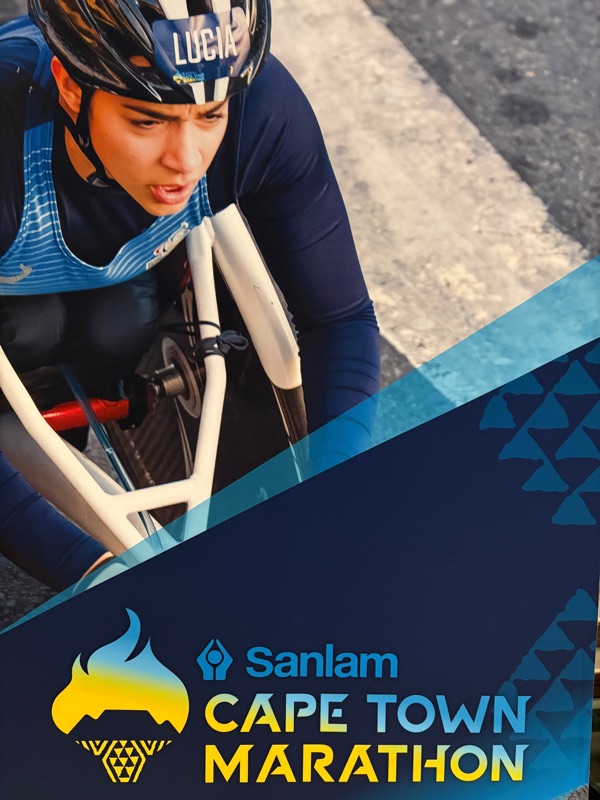
Table Mountain
Table Mountain in Cape Town is one of the world's most iconic landmarks and a symbol of South Africa's national identity.
For many visitors, Table Mountain is the single most memorable sight in Cape Town, especially at sunrise or sunset when the city, ocean and mountains are visible. Clouds spill over the flat summit like a blanket early in the day.
The top of the mountain is surprisingly flat. Geologists estimate that the rocks are over 500 million years old. There are over 23,000 species of plants, and it is considered one of the New 7 Wonders of Nature.
The rotating cable car to the summit is an engineering marvel giving passengers a 360 degree view during the ride.
I embarrassingly was unaware of the cable car's rotation and lost my footing when it started spinning around. A little bit of panic ensued. I'm sure the operator made an announcement, but I was busy snapping away. It's alway a good idea to pay close attention to announcements!
The price for a round trip ticket is R450 ( ~$27 USD). Arrive early to avoid a very long queue.
Often, it can become quite windy and the cable car will shut down temporarily but there are dozens of routes up the mountain if you are a hiker.
Once you reach the summit, there are plenty of paths to follow. This is a must-see in Cape town. Hopefully, the weather will cooperate.
On a clear day you can see Robben Island (Nelson Mandela was imprisoned there for 18 years), as well as the dramatic coastline of Cape Peninsula.
Small gopher like mammals, called Dassies, can be found lounging on top of the rocks. One of the most surprising facts is that their closest living genetic relative is the elephant. Another odd fact is that they urinate in a communal urinal. 😳
The Cape of Good Hope
The Cape of Good Hope is the most southwestern point of the African continent and is a UNESCO world heritage site. It is one of South Africa's most famous landmarks. The cape features towering cliffs above the ocean, making it one of the most photographed coastal landscapes of Africa.
Anyone who reaches this destination is obliged to be photographed at this sign, for which there is usually a substantial queue.

The scenery is beautiful and dramatic. Wildlife is everywhere. You can spot baboons, ostriches, antelope and whales during migration.
Apparently, the baboons are considered a nuisance by some of the locals. We did see a couple of men with "paint ball" guns to keep them away from certain areas. I guess the Cape Towners discovered this is an effective, harmless means of achieving their goals, but I wouldn't want to be a baboon hit by a paint ball!
I love penguins. They are such adorable creatures.
It is especially cool to see them in their natural environment.
I hope this was the first of more penguin colonies that I will visit, perhaps in other destinations.
We shall see ...
Boulders Beach, about 30 miles south of Cape Town, is home to a wild African penguin colony, the only penguin species native to Africa. The colony was established in the early 1980s when just a few breeding pairs settled there. Boardwalks and viewing platforms allow visitors to observe the penguins without disturbing their nesting area.
The beach gets its name from ancient granite boulders estimated to be about 540 million years old.
The Charming Wine Towns of Franschhoek and Stellenbosch
45 miles east of Cape Town are the picturesque towns of Franschhoek and Stellenbosch, settled by the French Huguenots in the 1600s, and known for the production of award winning South African wine. Many of South Africa's top restaurants are located here, making it one of the country's culinary capitals. Tours and tastings at the wineries can be booked in advance.
Rooibos Tea
If you are not a wine drinker (like me), a South African product worth trying is Rooibos tea, grown in the Cederberg mountain range. After harvesting, the plants are dried in the African sun, where they develop a rich red color. It is renowned for containing polyphenol antioxidants and henceforth, wellness properties. It is naturally sweet and has an herbaceous flavor.
Game Viewing on the St. Lucia Estuary
One of South Africa's most remarkable natural areas and a UNESCO World Heritage site is the St. Lucia estuary, home to one of the largest populations of hippos. Boat cruises operate off of the estuary where you can spot groups of swimming hippos and sunning crocodiles.
This is the best way to view the wildlife. At night, the hippos often leave the water to wander through the town and graze on the grass. That must be quite a sight!
The boat "safari" is just another experience to be added to your itinerary.
Boat at Dock
Hluhluwe-Imfolzi Game Reserve
Hluhluwe -Imfolzi Park, named for the rivers that flow through it, is the oldest proclaimed nature reserve in Africa, covering 370 square miles.
It is home to the Big 5 - lion, leopard, elephant, rhinoceros and water buffalo, among numerous other species. It is world famous, thanks to the conservationists, who saved the white rhinoceros from extinction. There were fewer than 100 white rhinos alive in the 1900s!
As a side note, capturing photos of wildlife from a jeep on a safari can be challenging.
There are usually a few individuals with keen eyesight for spotting a chetah relaxing in the grass quite a distance away.
Best strategy is to take multiple photos in succession so as to not miss the shot, then worry about the composition later. Most of these animals are on the move.
One of Africa's most famous wildlife reserves and South Africa's largest park is Kruger National Park. It covers about 7500 square miles and is considered to be one of the best places in Africa to see wildlife in a protected natural environment.
The best time for viewing is May through September when the animals gather around water sources and the brush is thinner. There were many guided game drives at the time of my visit.
The park maintains several camps for its visitors ranging from lodges to luxury safari tents. However, all vehicles are required to leave the park by 5:30 pm, no exceptions.
The jeep drivers and guides are great at spotting wildlife. This skill comes from trained eyes and knowing favorite animal hang outs.
It was very exciting seeing giraffes and elephants approaching the road, composed and serene, walking across to the other side. In spite of stories of occasional tourists getting in trouble, I never felt in danger.
I was psyched but glad our jeep was a safe distance away when lions came to the road searching for their cub. However, I did feel sad that they had to deal with so many human stalkers. Fortunately, nobody was dumb enough to provoke them.
Practical Tips (or what I learned on Safari)
1. Get up Early - lines form early at the park entrances. There is a daily limit to the number of vehicles permitted entry. Don't arrive late or you may be very disappointed.
2. Wildlife Viewings - If there are a bunch of jeeps clustered on the road, a sighting is imminent. Don't hesitate to check it out , or you may miss an opportunity. "Clustering" (my term) is totally acceptable safari behavior.
3. How to Dress - Wear layers since the morning drives can be on the chilly side.I had a beanie and gloves for the early hours. Our driver kept a supply of blankets in the jeep. We were very cozy and warm.
4. Camera Etiquette - This item is common sense. Since everyone in the jeep wants that special photo, take your shots quickly. You may need to sit down or move over to give others an opportunity to capture that moment. The folks in my jeep were mostly cognizant of others, so this wasn't really a problem, but I thought I would mention this courtesy anyway.😉
Last Stop - Johannesburg
Johannesburg is the largest city in South Africa and the country's main financial and economic hub, built on gold mining in the late 1800s. There are modern skyscrapers and historic, cultural areas like Soweto. The city also serves as the gateway to Kruger Park.
It is an area where the contrast between the rich and poor becomes evident. The neighborhood of Sandton contains luxury hotels, homes, and shops surrounded by poorer communities. Johannesburg has high crime in these areas. It is not a place to wander around at night.
As a solo traveler, I do enjoy the 'wandering' aspect of travel, but we were forewarned not to do so in Johannesburg. It is not uncommon for tourists to be targeted. As a solo woman, you need to be smart and if you do wander, join a group, if possible. Safety first.
Culturally, it is important to experience Soweto, where Nelson Mandela lived a good part of his life and is an integral part of the country's complex history.
Apartheid can be further experienced by visiting other sites such as the prison museum in downtown Johannesburg, on Constitution Hill , adjacent to the working Parliament or visiting the Apartheid Museum. These experiences will offer perspective and understanding of the country's history and struggles.
Apartheid Prison Museum
Prisoners - Nelson Mandela and Mahatma Gandhi (incarcerated at different times)
South Africa is a place that will inspire and surprise you with its stellar scenery, incredible wildlife, rich cultural heritage, and resilient spirit.
Go ahead and add SA to your travel destination list!


