Exploring Split
Split is the perfect starting point for exploring Croatia's Dalmatian Coast, with its ancient palace, waterfront promenade, and easy access to historic towns, islands and national parks.
Life here is slow and relaxed. Tourism plays a major role in the local economy and English is widely spoken.
Croatia, once a republic of communist Yugoslavia, has emerged as a popular tourist destination since transitioning to a democratic society in the 1990s.
The country borders the beautiful Adriatic Sea, across from Italy's east coast. Much of Croatia's allure lies in the quaint, picturesque towns and islands along its rugged coastline, many of which have retained their historic character despite the country's popularity.
I stayed at the modern, clean Hotel Amphora, about a ten minute ride to town. It is a large hotel which serves many tour groups and sits across from the lovely Znjan beach.The beachfront promenade is popular with runners, cyclists, dog walkers and families and is active throughout the day and evening. There are also plenty of restaurants and bars along the beach.

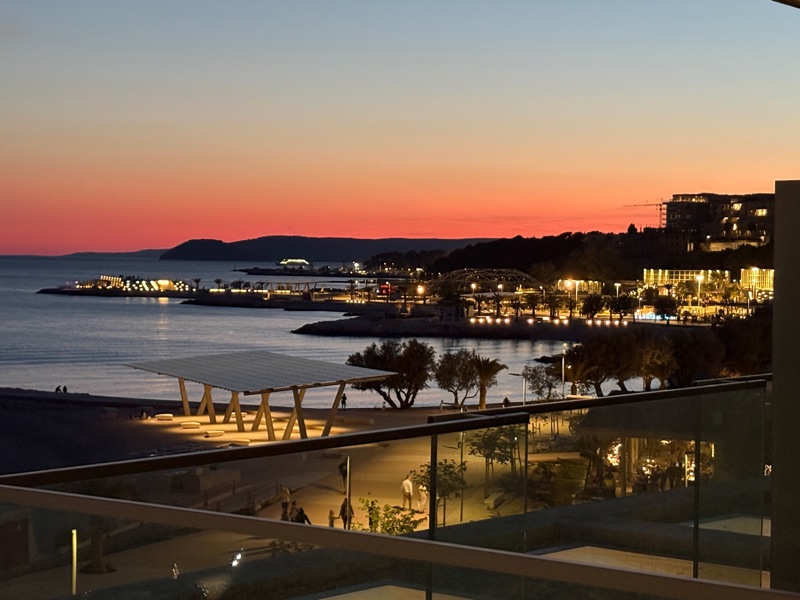
During the shoulder season in April, preparations for the summer season begin. It’s an ideal time to visit as stores and restaurants are open and are not overcrowded.


DIOCLETIAN PALACE IN SPLIT
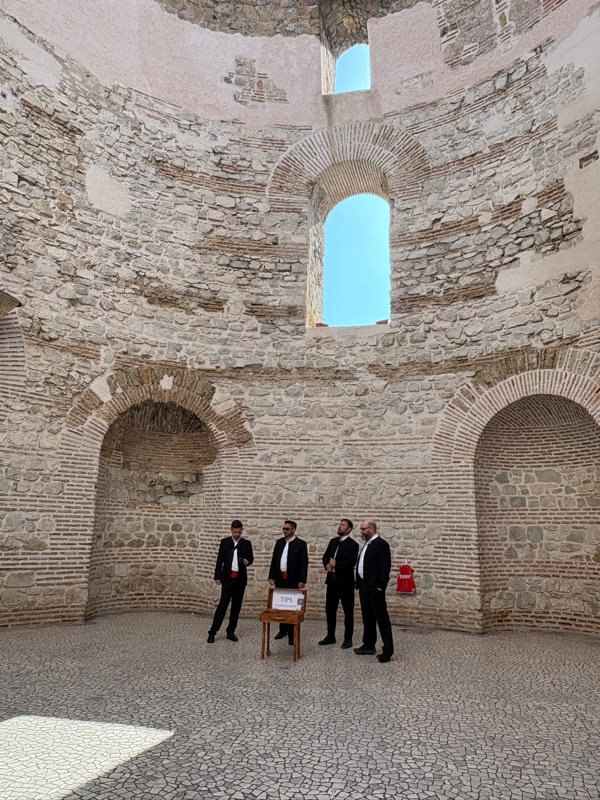
Diocletian’s Palace, the signature attraction of Split’s Old Town, was built in the early 4th century as a residence for the Roman Emperor Diocletian. Despite its name, it is more like a fortified city, with thick walls, towers and gates.
The palace gradually became part of the city, with homes and businesses built within its ancient structure. Over the centuries, it has become a fascinating mixture of Roman ruins and everyday life that you see today.
The palace is the heart of Split and is used for special events and festivals. The streets within the palace grounds are lined with charming shops and eateries. You can easily get lost in the winding alleyways


During my visit, vendors and local artists displayed jewelry, paintings, ceramics, and products made with lavender and olive oil. Nearby, Split’s colorful farmers market offers fresh produce and other local specialties.
The Riva, Split’s lively waterfront promenade, stretches along the harbor beside Diocletian’s Palace. Lined with cafés and palm trees, it is a wonderful place to stroll, people-watch, or simply enjoy the view of the Adriatic.
GETTING TO THE DALMATIAN ISLANDS FROM SPLIT
One of the highlights of visiting Split is the easy access to the Dalmatian islands. Ferries leave from Split's harbor, conveniently located near Diocletian’s Palace, making an island visit an easy day trip.
Here you’ll find plenty of sunshine, stone villages, turquoise water, beautiful beaches and centuries of history. Each island has its own distinct personality.
I visited Brač Island, including the charming town of Supetar, with its beautiful harbor. The island also offers small villages, wineries, parks and wonderful views of the Adriatic Sea and surrounding islands. It’s definitely worth spending a few hours there, and getting there by way of a ferry ride from Split is part of the experience.
Hvar has a different reputation. It's known for its nightlife, yachts, historic town, beaches and lavender fields. It is farther from Split and generally involves a longer ferry trip.


KLIS FORTRESS NEAR SPLIT


Fans of HBO’s Game of Thrones may recognize Klis Fortress, an imposing medieval fortress in the hills just outside Split where scenes from the series were filmed. The elevated location also offers sweeping views of Split and the surrounding Dalmatian landscape.
While I found Klis Fortress interesting, I thought the attraction was a bit overhyped. Still, it was worth seeing, particularly for the views and its long history beyond its Game of Thrones fame.
KRKA NATIONAL PARK
About 90 minutes from Split is Krka National Park, one of Croatia's most famous natural attractions and an easy day trip from the Dalmatian Coast. The park is known for its cascading waterfalls, lush scenery, wooden walkways and beautiful turquoise water.
Farther from Split is Plitvice Lakes National Park , another spectacular Croatian park famous for its interconnected lakes and waterfalls. While Plitvice requires a longer trip, both parks offer a beautiful contrast to the historic towns and islands along the coast.


Nearby is a town frequently visited by Bill Gates. Can you spot his yacht?
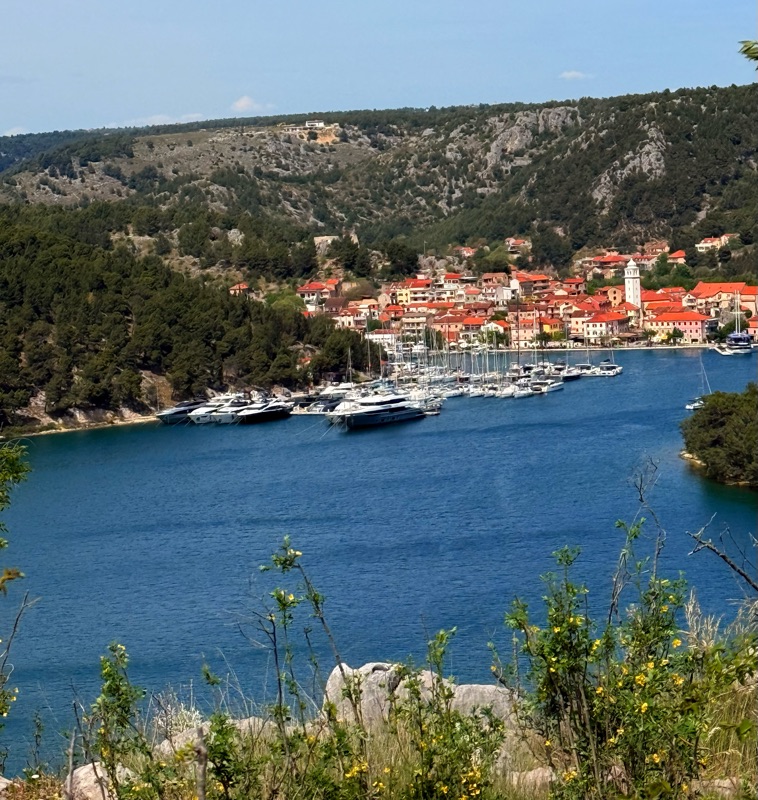
* photo courtesy of Vivian P.
DAY TRIP FROM SPLIT TO MOSTAR, BOSNIA HERZEGOVINA
About 2½ hours from Split, Mostar, in southern Bosnia Herzegovina makes a fascinating day trip. The city reflects a mixture of Ottoman, Austrian-Hungarian, and Slavic influences.
Because you are crossing an international border, remember to bring your passport.
The Bosnian War (1992-1995) was a terrible, violent conflict centered around territorial control and ethnic nationalism. Evidence of the war can still be seen in parts of the city. Who would have guessed that I would ever visit this region!
Mostar’s most famous landmark is Stari Most, or the Old Bridge, originally built in the 16th century during the Ottoman period. The bridge was destroyed during the Bosnian War and later reconstructed. Today, it once again spans the Neretva River and has become a powerful symbol of the city’s recovery.
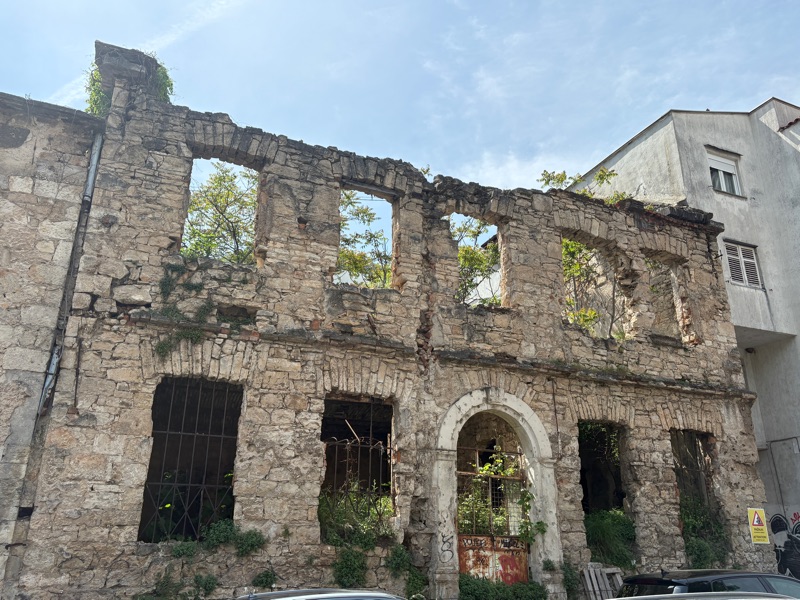 Building remnant from Bosnian war

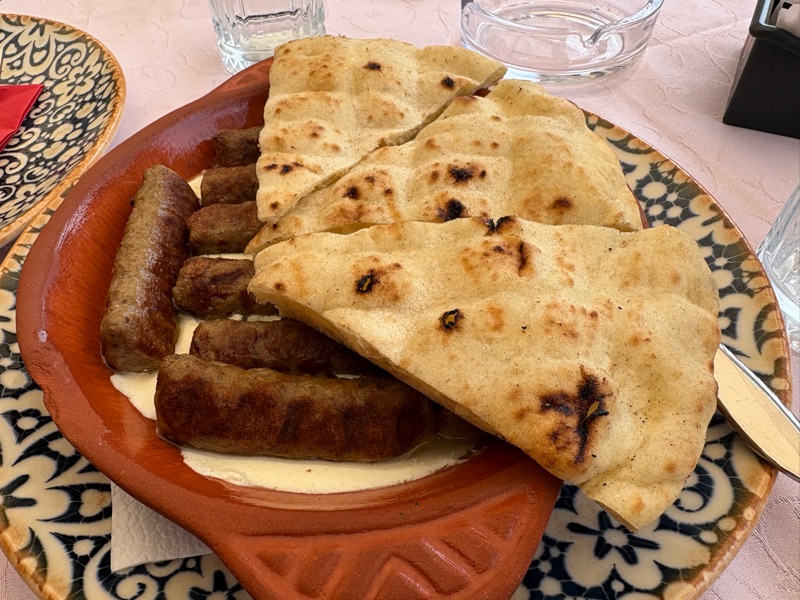
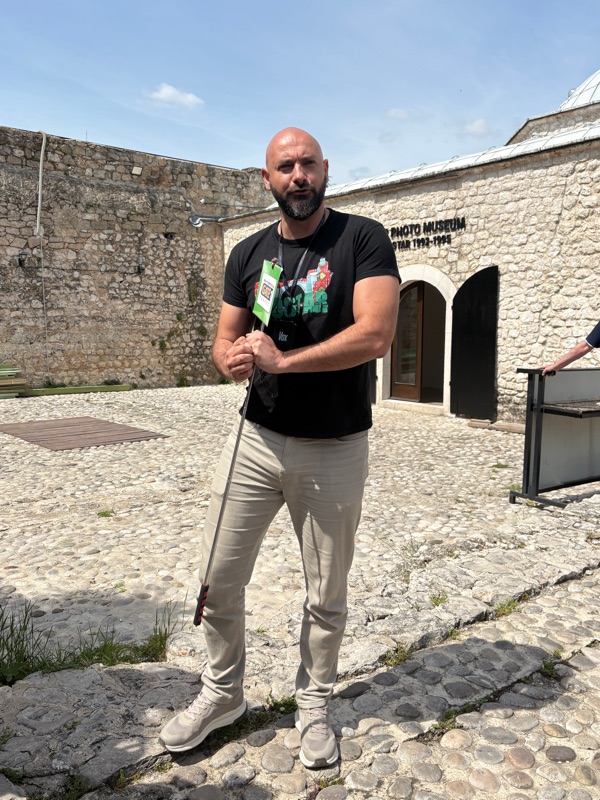
Our guide (part-time comedian) 🤪
DAY TRIP FROM SPLIT TO SIBENIK
About an hour from Split, Sibenik is a historic and very walkable city on Croatia’s Dalmatian Coast. Founded by Croats and first mentioned nearly 1,000 years ago, its Old Town is smaller and quieter than Split’s, making it easy to explore on foot.
The highlight is the Cathedral of St. James, a UNESCO World Heritage Site built entirely of stone and blending Gothic and Renaissance styles. Šibenik is also known for its impressive hilltop fortresses, which offer dramatic views over the city and Adriatic Sea. In between, there are plenty of narrow, meandering streets to explore.


DAY TRIP FROM SPLIT TO TROGIR
Along the Dalmatian coast, Trogir, is a small historic town set on its own island and connected to the mainland by bridges. Its beautifully preserved Old Town is yet another UNESCO World Heritage Site and makes an easy day trip from Split.
The main attraction is the Cathedral of St. Lawrence, known for its impressive Romanesque architecture and intricately carved portal. But Trogir itself is the real attraction, with narrow cobblestone streets, stone buildings and Venetian architecture that make it a pleasure to simply wander.


MY TAKE ON CROATIA
I didn't know what to expect when traveling to Croatia. I had heard that the Dalmatian Coast was breathtaking, and indeed, it was absolutely stunning in places, with clear turquoise water and beautiful coastal scenery.
Most of the excursions were pre-arranged by a tour group, so it was relatively easy getting around. For those with mobility issues, the tour advised about strenuous climbs uphill, for instance to Klis Fortress. Some people abstained, but I found that it really wasn't that challenging after all. Most of the treks were on relatively flat surfaces, although the surface could be a bit uneven in spots.
After spending a few days in Croatia, I was also impressed by the relaxed lifestyle I observed. Each evening, I would see entire families walking, playing and simply enjoying themselves together along the beach promenade.
Croatia has endured tremendous struggles throughout its history, and perhaps some of that history has contributed to the resilience I sensed during my visit.
There is something to be learned from a place where people seem to make time for family, community and simply enjoying where they are.
Traveling on your own? Read more about my experiences and advice on my Solo Travel page. If you enjoyed Croatia, you might also like my travels through Greece, Turkey and Italy.